
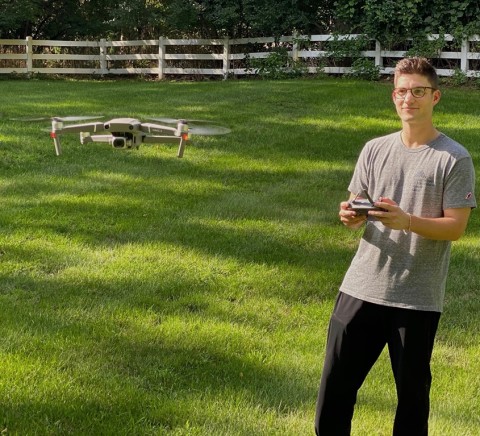
Connor Tukel is a current second year student at the Icahn School of Medicine at Mount Sinai, anticipating graduating in 2023. Read on to learn about the projects he is working on at ISMMS and what it is like to be a medical student during a national pandemic. Further reading about his drone naloxone delivery research can be found in BMJ Innovations here.
What brought you to ISMMS?
I remember visiting for my FlexMed interview back in sophomore year of college and getting a feeling that this was the place I wanted to end up. Fast forward to my senior year, when I was back for another interview, and I got this same indescribable feeling – of awe and excitement, of nervousness about messing this ‘second chance’ up, but also of optimism about having been invited back for another shot. I remember meticulously crafting emails to my interviewers, to Dr. Parkas, and really to whoever else would listen, trying to convey how I really truly identified with and saw myself fitting into the Mount Sinai community while, at the same time, trying to not be “too forward”, or cross any lines with regards to interviewee behavioral etiquette. I genuinely could not be happier with or feel more validated about my decision to come to Sinai.
What do you like most about being a student at ISMMS?
This school –and the institution more broadly– celebrates innovative thinking, creative problem-solving, and interdisciplinary collaboration. I really appreciate being able to learn medicine in an environment that not only encourages my classmates and me to question the status quo, but that also actively empowers us to do so by fostering a sense of agency that makes us feel like we can actually impart real-world change, both within the context of healthcare and beyond. We’re granted independence and flexibility, but also support and guidance as we follow our curiosities and channel our passions into projects aimed at improving the communities around us in various ways. I’m constantly amazed by the scientific research, advocacy work, and entrepreneurial ventures undertaken by my peers (even in our first year!).
What advice would you give a current student at ISMMS including advice for a prospective student pursuing medical school?
Enjoy the journey and make sure to be present along the way. It’s certainly easy to get caught up in the day-to-day work, or to feel overwhelmed by a sense of needing to be involved in so many different extracurriculars, but studying medicine (and learning the anatomical structures/physiological processes that form the basis of this field) is really really cool; and, every so often I have to remind myself to not think about the reviews, or other non-academic obligations I have after class, and instead simply let myself be wholly present so that I can fully internalize and appreciate the objectively insane things that we encounter in class on a daily basis. Sometimes I take for granted the years of investigation that went into generating the knowledge present on even a single one of our lecture slides, and so my advice here is to try to just remember that as difficult as pursuing this path might be (I.e. from a practical, daily routine perspective), we’re incredibly fortunate to have the opportunity to do so, not only because of our acceptances to medical school, but also because of the work of our predecessors who shared our passion for inquiry and determination to understand the many mysteries of the human body.
How has your day to day been disrupted because of the ongoing COVID crisis?
The COVID-19 pandemic forced many of my classmates and me to leave our NYC campus and complete the last part of our first year of medical school from our respective home states. I was disappointed by the suspension of in-person lectures, laboratories, clinical simulations, patient presentations, etc., as these things represented some of my favorite parts of our curriculum. It has been much more difficult, for me at least, to connect with the material when I’m simply watching videos of lectures or left to read the material by myself. It’s definitely also difficult not being able to learn alongside and generally spend time with my friends. Our class is particularly cohesive, and so it’s tough not being able to hang out in the library, or crack jokes as we all pile into the Annenberg elevators one minute before we need to swipe in for a mandatory class. Medical school encompasses far more than just the learning that takes place inside the lecture hall, and, unfortunately, this situation has prevented us from enjoying many of those non-academic things that made the first half of our first year so great.
What do you want people to know about this crisis?
That this is all very unprecedented, and everyone is doing their best to figure things out, despite having never expected, or prepared for a situation of this nature and scale. I want to emphasize that in addition to communication and transparency we need to have patience with one another. All of us must be sensitive to the unique implications this situation has had on each of our lives, and we must also understand that everyone has had to adapt their personal and professional lives – often in very drastic ways – over the course of only a few months.
Are you participating in research, and if so what is it on and why did you choose this project?
As part of our school’s SCHOLaR summer research program, I’m working, under the mentorship of Dr. Jacob Appel, on a project to quantitatively and qualitatively evaluate the incidence of hate crimes directed at Asian American and Pacific Islander (AAPI) New Yorkers during the COVID-19 pandemic. We’re running statistical analyses using publicly available FBI hate crime data and NYPD complaint/arrest reports, as well incorporating self-reported instances of assault/harassment that have been collected via survey by researchers at San Francisco State University. At the same time, I’m working with my brother –a fourth year medical student at Wayne State University School of Medicine– to launch an investigation exploring how drones might be used to streamline the COVID screening/testing process. I chose to work on these and a few other projects because they relate to very relevant problems, and I want to do my part to help address issues that continue to affect so many people.
What is your proudest accomplishment so far?
I get tremendous pride and joy from working on and completing different kinds of “projects.” I’ve helped launch and grow an energy drink company, developed a virtual reality experience to showcase different cultural sites around my hometown, built and carried out research projects using drones, and, this summer, I’ve been trying to learn the ins-and-outs of super 8 cinematography and 35mm film photography. I am proud of all of these experimental undertakings, as I feel like each one, in its own right, has helped me become more creative, more resourceful, and more capable of following my curiosities and passions even when I encounter barriers or inevitable failures along the way. I am grateful for the democratization of knowledge that comes with living in the Information Age, and I would ultimately say I am most proud of the fact that I have asked questions or come up with ideas, and – undeterred by how much, or, more accurately, how little I knew at the onset – successfully answered those questions or developed those ideas into concrete short/long-term projects.
Tell us about your use of technology.
The potential applications of unmanned aerial vehicles (or, “drones”) are immense, and researchers and entrepreneurs around the country and world have, for many years now, been exploring a myriad of uses; however, use of drones specifically within healthcare represents a fairly emergent area of study.
My brother and I theorized one healthcare-related use case –rapidly delivering naloxone to the scene of opioid overdoses– that we felt to be incredibly significant given the scope of the opioid epidemic, as well as the fact that there is an effective intervention (naloxone) but one whose administration is very much time-dependent. If a drone could indeed travel faster than traditional ambulances, then it might represent a valuable tool to empower bystanders who are already on-scene to intervene with naloxone even before first responders arrive. This was thus the subject of our first research project.
Drones are simply platforms, and there’s no reason to believe that they can’t also be outfitted with a host of other medical payloads/sensors/systems. For instance, we are currently working to launch an investigation wherein we’ll be simulating how an autonomous fleet of drones meant to transport COVID swabs from testing sites to different labs might be useful in overcoming logistical barriers that currently limit the efficiency of the COVID screening process. There is very little research on how a coordinated network of medical delivery drones would practically operate, but it certainly seems like use of drone technology for this purpose could prove very valuable (especially right now in the midst of this global pandemic). We are therefore working once again to establish baseline validity that, if our results are promising, can then hopefully instigate and inform future investigations to further elucidate the viability and practicality of using drones to streamline, or otherwise improve the delivery of clinical care.
Do you know what field of interest you would like to pursue, if so what is it?
At this point, I’m not sure what area of medicine I want to pursue. Shadowing has definitely been good in helping me see a number of specialties, but the problem is every time I shadow –a plastic surgeon, an ENT, a psychiatrist– I walk away thinking about how what I saw that day was the coolest thing I’ve seen, which unfortunately perpetuates my indecisiveness.
I did spend some time at SpaceX with a few of my classmates at the beginning of the summer, and that helped me discover the field of aerospace/extreme medicine – a field that I hadn’t even heard of beforehand. I really identified with the deliberate planning and resourceful decision-making that goes into treating patients in these extreme environments, and so I’ve spoken with a few doctors who work in this area and even gotten involved in some of their research projects as well. So, currently, I find this area of medicine to be incredibly exciting/engaging/awesome; but, fortunately, going through medical school is a long process, so I still have quite a bit of time before I need to make a final decision about what exactly I want to do.
- Is there something special you would like the alumni community to know about you?
I would just reiterate how thrilled I am to be part of this community and also echo the fact that my classmates and I are super excited to continue engaging with and learning from all of our institution’s alumni. The Mount Sinai community comprises an incredibly robust, incredibly diverse group of smart, driven leaders who are united by our shared mission to disrupt and improve healthcare so that we can do the most good for the most amount of people. Many Sinai-trained physicians and scientists have already done these things, and I therefore want to emphasize that we –the doctors in-training– are eager to learn from those who’ve sat in the same Annenberg lecture halls and lived in the same Aron Hall apartments as us and then gone on to impact medicine/society in such profound ways!